
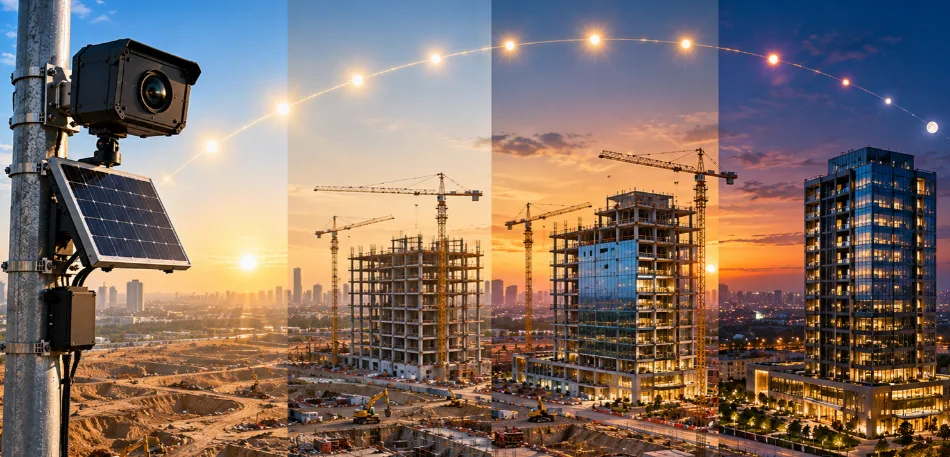
One storm, one nudged bracket, and weeks of footage stop lining up. Where you put a professional timelapse camera decides whether the record reads as one steady story or a stack of mismatched frames. This guide covers viewing angle, mounting height, power planning, camera orientation, and installation continuity, so the setup holds from the first day to handover.
What Do Timelapse Cameras Need Before Anyone Pick a Pole?
Placement matters as much as the timelapse cameras. The working rule is short: mount it high, keep it outside the work area, put the sun behind it, and frame the full height of the finished building from day one.
Start with purpose. Some teams need pictures for a planning officer, some want a clean record for a client, and others want proof of how the site looked on a given day. That reason tells you where to point the lens and how often you will pull records.
Climate then shapes the details. Anyone searching for the best time lapse camera Saudi Arabia will weigh heat and off-grid power. Those comparing the best cameras for timelapse in UK will weigh rain, wind, and short winter days.
Viewing Angle: Frame the Finished Building
Start Wide and Leave Headroom
On day one a site is flat ground, which tempts people to crop tight. Frame the full height of the finished structure now, even if most of the picture is empty sky. Keeping the sun behind the camera lights the building’s face instead of leaving it dark. Staying outside the work area keeps cranes and heavy equipment from blocking the view.
Large Sites and Interiors
On very large footprints, 360° monitoring from several control points gives coverage no single camera could, and every feed lands in one dashboard. Retrofit and listed-building jobs add interior monitoring, a room-by-room record of the kind conservation officers ask for.
Mounting Height and Camera Orientation
Height and Mount Strength
Mount high enough to look over the work, not into it. Strength matters too. If a storm shifts the camera even slightly, the angle changes and the record stops lining up, which is why UK installs use wind-rated mounts. Work at height carries real risk, so agree to the installation method with the site safety officer first.
Facing the Light
Orientation is mostly about the sun. Face away from it, not into it. Winter adds a wrinkle in the UK, where daylight is short. Ask how a camera behaves at 4pm in December, not only at noon in summer, because the aim is usable images rather than a dark frame by late afternoon.
Power Planning for a Professional Timelapse Camera
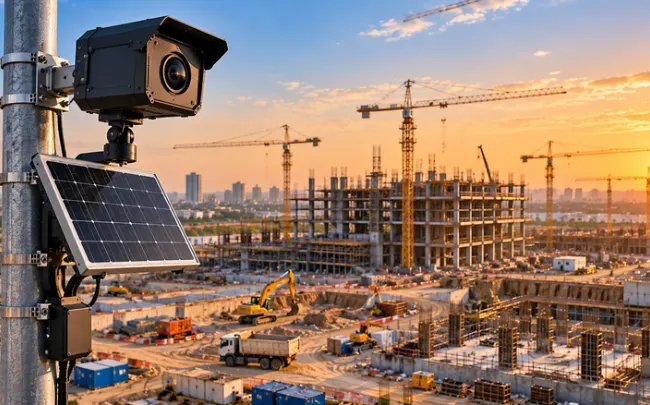
Power decides whether the record survives the whole project. Solar with a battery suits a site with no steady mains supply. Main works once the site electrics are in. Sites without grid power nearby are common on projects like NEOM, and a solar unit runs entirely off-grid there.
Heat needs its own check. Many cameras are rated to only 49 to 55°C. Summer air in Saudi Arabia and the UAE often reaches the mid-40s °C, and a camera in direct sun runs hotter than the air around it, so ask for the highest heat rating you can get. For weather, look for IP66 or higher so rain and dust stay out.
Data needs a way out as well. A built-in 4G or LTE link that sends photos to cloud storage means nobody collects memory cards. Main connections belong to a qualified electrician working under local rules.
Installation Continuity: Keeping Every Frame Matched
Gaps are the first thing people question. A camera that copes in June but struggles in a wet October leaves holes in the record. A professional timelapse camera is only as useful as the unbroken run it produces.
Resolution plays a part. Between 5 and 12 MP is enough for most progress records. Go above 12 MP if the photos may be used in a dispute or claim, because more pixels allow zooming in later. A dashboard of dated, sorted pictures lets you open the week or milestone you need instead of scrolling thousands of frames. When a delay is questioned, everyone checks the same record.
Final Thoughts
Good placement is a set of small decisions made before the first photo: a wide frame, a high and sturdy mount, a direction that keeps the sun behind the lens, power that fits the site, and a record built to run without breaks. Rawadh publishes regional notes on timelapse work in Saudi Arabia and the UK that show how site conditions change each choice. Which of these five decisions would break your record first if it went wrong?
FAQ
How high should I mount a timelapse camera on a construction site?
High enough to look over the work rather than into it, and outside the work area. Frame the full height of the finished building from day one, and keep the sun behind the lens. Agree on the install method with your safety officer first.
Do timelapse cameras work without mains power?
Yes. Solar with a battery suits sites without a steady mains supply, and a solar unit can run entirely off-grid. Mains works once the site electrics are in, and a qualified electrician should handle that connection.
What picture quality do I need for a progress record?
Between 5 and 12 MP covers most progress records. Go above 12 MP if the photos could end up in a dispute or claim, since extra pixels let you zoom in later.
Why do UK sites need wind-rated mounts?
A storm can shift a camera slightly, and that changes the angle so frames no longer match. A wind-rated mount keeps each frame lined up with the last one.

Leave A Comment