

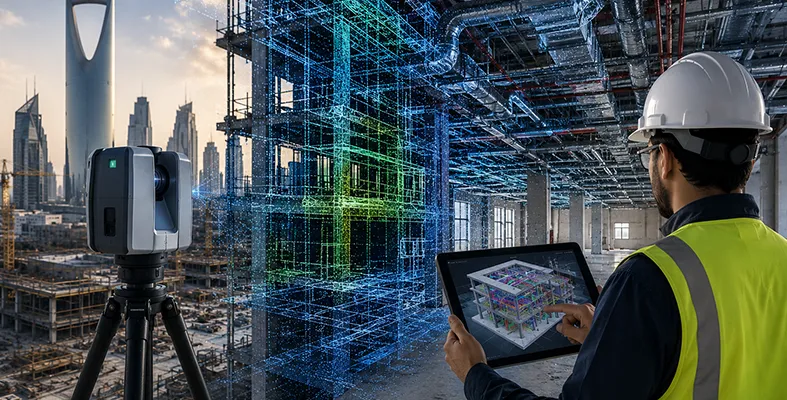
Millimetre-accurate scans of what’s actually built, not what the drawings say should be there. The base data behind BIM models, building records, and as-built documentation is delivered across Saudi Arabia, the UK, and Germany.
A drone shows you the roof. A timelapse camera shows you the last six months. Neither tells you if that wall actually sits where the drawing says it does. That’s the gap laser scanning fills.
A scanner walks the site and captures millions of measurements, every wall, duct, and beam, exactly where it sits. That data becomes a point cloud, and from there it turns into whatever you need: a coordinated BIM model, a full building record, or an as-built survey handed over at close-out. All three come from the same underlying scan, just processed differently depending on what the deliverable needs to do.
A coordinated 3D Revit model, built from a laser scan of your site, so your architect, MEP contractor, and site team are finally looking at the same building.
We scan the site using high-resolution laser scanning equipment, working room by room or floor by floor depending on size. For occupied or active sites, we can usually work around ongoing operations rather than requiring a full shutdown.
Your role in the process:
We’ll also ask you to confirm the detail level upfront; a full MEP layout takes longer to model than a basic shell-and-core, and which parts of the building actually matter since not every project needs the whole structure modelled.
The scan data gets converted into a coordinated 3D model, checked against any drawings you’ve supplied, typically to LOD 200–300 for construction and renovation work. This is where clashes between the design and what’s already standing get caught, like a pipe routed through a beam or a wall shifted from where the drawing says, before they turn into a change order on site.
The model reflects what the scanner can physically see. Anything behind a finished wall, under a floor, or inside a sealed duct won’t appear unless you can supply drawings or specs for it. We flag any gaps like this once scanning is done, so nothing’s a surprise when you’re reviewing the model.
You get a Revit-ready BIM model, the raw point cloud, and a clash report if anything comes up. Delivered in Revit, IFC, or CAD, whatever your team works in.
When the original drawings are missing or years out of date, a BIM scan gives your design team a reliable starting point.
Scan again partway through the build and compare it to the model to see what’s actually gone up. Handy when an owner wants a second opinion that isn’t just the contractor’s word.
MEP and structural conflicts get caught on screen instead of on site, where fixing them costs real time and money.
Once handed over, the model becomes a digital twin your team can reference for maintenance and space planning long after the project closes.
We run this across active construction sites in Riyadh and the rest of Saudi Arabia, and through the same process for projects in the UK and Germany.
A full digital record of a building’s condition and layout at a specific point in time, stored and searchable, not a folder of photos nobody opens again. Facility teams across Saudi Arabia, the UK, and Germany use this as their baseline record, especially on older buildings where nobody’s fully sure what condition things are in
We scan the building using the same laser equipment used for BIM work, capturing every space to the millimetre. Depending on what the record needs to cover, we can scan a single floor, a full building, or a whole site.
Your role in the process:
The scan data gets organised into a structured record: dimensions, floor plans, condition notes, and photos, all tied back to the point cloud so any measurement can be checked later.
This isn’t a structural survey or a safety inspection, and it doesn’t come with an engineer’s sign-off on condition or code compliance. We document what the scanner sees, not certify a building meets a particular standard. If you need that kind of certified assessment, we can point you towards the right specialist and hand over our scan data to support their work.
You get the full point cloud, floor plans, and a condition record, in whatever format your team works in.
Drawings show what someone intended to build. An as-built survey shows what actually got built, and on any project of real size, something usually shifts between the two.
We scan the finished structure with the same laser equipment used across our other services, timed right at project completion, before finishes go up over anything that still needs checking. This applies whether the project’s in Riyadh, elsewhere in the Kingdom, or one of our UK or Germany sites, timing at handover matters everywhere.
Your role in the process:
The scan gets converted into as-built drawings or a model and checked against the original design so any deviation is visible and documented. Where the structure matches the design, that gets confirmed too; this isn’t just a list of problems.
An as-built survey confirms what’s there, not why it’s there or whether it meets code. If a deviation shows up, that’s a conversation for your engineer or architect; we just make sure it’s on record with exact measurements attached.
No. We can build one from scan data alone. Drawings just help us fill in what the scanner can't see, like what's hiding behind a finished wall.
Same scan, different purpose. BIM scanning gives you a working model for design and coordination. Documentation is a standalone record of a condition. An as-built survey checks the finished structure against the original design and flags what's changed.
Almost anything, residential, commercial, industrial, heritage. Age and condition don't rule a site out.
Depends on the site. A single floor might be a few hours; a full tower, a multi-day job. We'll confirm once we know the scope.
Usually LOD 200–300 for construction and renovation projects. If your project needs LOD 400, tell us upfront, since it changes the scan approach and timeline.
Revit, IFC, and CAD, along with the raw point cloud if you want it on file.
Riyadh and the rest of Saudi Arabia, with the same service running through our UK and Germany teams.