

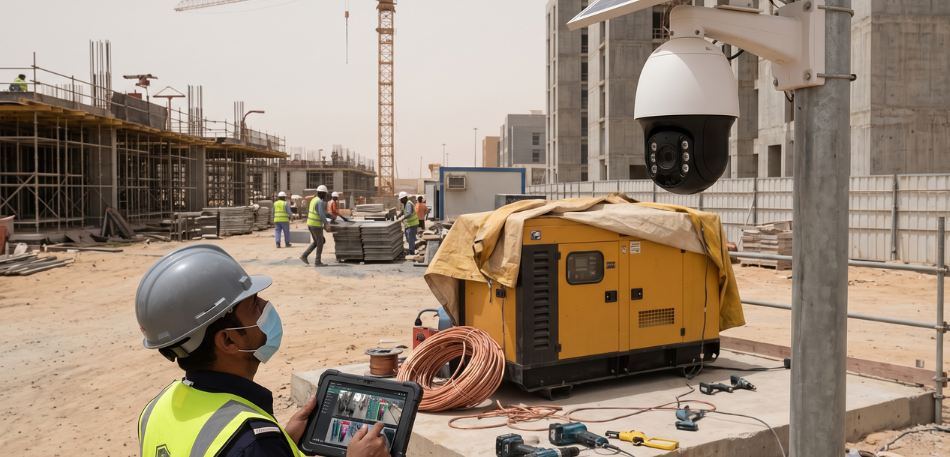
A single stolen generator can shut down a Riyadh job site for days while a replacement clears customs and gets delivered. That kind of delay is exactly why a construction security camera now sits on the procurement list next to site fencing and scaffolding, not as an afterthought bolted on after something goes missing. Theft, vandalism, and the liability disputes that follow cost contractors far more than the price tag of the missing equipment. A camera watching a site today has to do more than record footage nobody checks until it’s too late.
What Actually Goes Missing, and When?
Fuel, copper wiring, hand tools, and small machinery disappear from sites more often than the big equipment does, mostly because they’re easier to carry off and harder to trace back to a specific project. The National Equipment Register (NER) and National Insurance Crime Bureau estimate that construction equipment theft costs the industry between $300 million and $1 billion each year, with fewer than 25% of stolen machines ever being recovered. Numbers like that don’t map directly onto a Gulf job site, but the pattern behind them does.
Unmonitored laydown areas and weekend gaps in coverage are where losses pile up everywhere, regardless of country. This is where construction monitoring stops being a nice-to-have and starts functioning as a daily operational habit, checked the same way a site manager checks the weather before pouring concrete.
How Timelapse and AI Detection Change What You See
A fixed camera that only records is barely different from a padlock with a lens attached. What changes the equation is a platform that turns raw footage into something a project manager can actually use. Rawadh’s construction monitoring runs on Binalapse, a system that pairs solar or mains-powered cameras with AI that flags vehicles, people, and missing hard hats without anyone needing to scrub through hours of video by hand.
Timelapse cameras on the same installation stitch daily stills into a single continuous record, from groundbreaking through handover, so a dispute over “when did this wall go up” gets settled by scrolling a timeline instead of arguing from memory. Image comparison tools let a manager drop two dates side by side and see exactly what moved, what didn’t, and what’s missing. None of this replaces a site guard walking the perimeter, but it gives that guard, and everyone above them, a record that doesn’t rely on someone remembering to write it down.
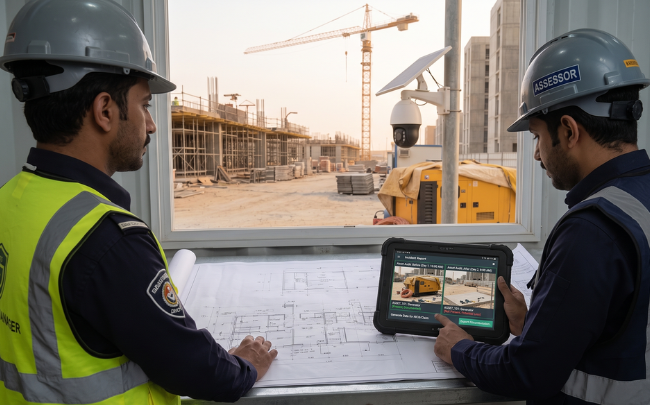
Why the Footage Matters When a Claim Gets Filed
Liability claims on a construction site rarely come down to a single clean story. A subcontractor says the damage happened before their crew arrived. An insurer wants proof the site was secured on the night in question. Insurers weigh footage alongside everything else in a claim file, not instead of it. What a timestamped image gives you is a fixed point nobody can quietly dispute later, like proving a wall was already cracked before your crew ever touched it. That’s the practical value a construction security camera adds once a claim is already in motion. Anything beyond that belongs to a broker or a lawyer.
Reports that generate automatically on a schedule, rather than being assembled after the fact when a claim is already underway, tend to hold up better because nobody had a reason to shape them around a specific incident. For anyone weighing how documentation affects a claims process, it’s worth reviewing guidance from a body like the National Insurance Crime Bureau, which tracks how equipment theft and recovery data gets used across the industry.
What a Monitored Site With a Construction Security Camera Looks Like Day to Day
In practice, this isn’t a bank of monitors someone stares at for all shifts. It’s a dashboard, checked from a phone or a laptop, showing live feeds from whichever cameras are active plus whatever footage got flagged overnight. Sites already running CCTV don’t need to rip it out either; platforms like Binalapse integrate with most existing IP camera setups, so the monitoring layer sits on top of hardware that’s already installed.
For contractors juggling several sites at once, that single login matters more than any individual camera spec. One dashboard instead of five separate systems means fewer places for something to slip through unnoticed. Anyone comparing options can look at Rawadh’s timelapse camera solutions to see the range of cameras and what each one is built to catch.
Final Thoughts
A camera on a pole won’t stop every theft or settle every argument about who’s responsible for what. What it does is remove the guesswork, replacing “I think that happened on a Tuesday” with a timestamped image nobody can dispute. For a site manager weighing where the next security budget goes, the question worth asking isn’t whether cameras help. It’s whether the current setup gives a clear enough record to stand up when something actually goes wrong.
FAQ
Do construction security cameras actually stop theft or just record it after the fact?
Mostly the second one, and that's still valuable. Visible cameras do deter some opportunistic theft, but their bigger role is giving you dated proof of what happened and when, which matters just as much for insurance and dispute resolution as prevention does.
How is a timelapse camera different from a regular CCTV setup on a construction site?
CCTV is built to watch. A timelapse camera is built to document change over months, stitching daily stills into one continuous progress record. Many setups, including Rawadh's Binalapse, do both from the same unit.
Can these cameras run on a site with no fixed power or internet?
Yes, most systems built for construction, including solar and SIM-connected models, are designed around that exact problem. They don't rely on site infrastructure that might not exist yet in the early phases of a build.
Will footage from a site camera actually help if a liability claim goes to insurance?
Insurers weigh footage alongside everything else in a claim file, not instead of it. What a timestamped image gives you is a fixed point nobody can quietly dispute later, like proving a wall was already cracked before your crew ever touched it. Anything beyond that belongs to a broker or a lawyer.
Do I have to replace my existing CCTV to add construction monitoring?
No, in most cases. Platforms like Binalapse are built to connect with IP cameras already installed on site, so the monitoring and reporting layer gets added without swapping out hardware that's already working.
Leave A Comment