

A building site surveillance camera settles arguments that used to run for weeks. Contractor disputes over missed deadlines, disputed workmanship, or changed site conditions rarely come down to who’s telling the truth. They come down to who has proof, and proof needs a timestamp
What Do Timelapse Cameras Actually Record?
Timelapse cameras solve a specific problem: nobody can stand on a site every day to watch what happens. A camera mounted at a fixed point, solar or mains powered, captures the build from groundbreaking through to handover as a dated photo sequence. Rawadh runs this through its Binalapse platform, which pulls the footage into one dashboard rather than leaving it scattered across separate hard drives. AI detection flags vehicles, personnel, and hard hat compliance automatically, so nobody has to sit and scrub through hours of raw footage looking for the one frame that matters. Scheduled PDF reports land in an inbox on a set day. None of that requires a site visit.
Where Contractor Disputes Actually Start
Most disagreements on a build fall into a short list: work that a contractor says was finished on time but a client says wasn’t, materials or methods that don’t match what was specified, or site conditions that shifted mid-project and changed the scope. Verbal accounts of any of these tend to contradict each other within a week. A dated image doesn’t contradict itself. When a foundation pour is questioned six months later, or a subcontractor claims access was blocked on a specific date, the camera either backs the claim or it doesn’t.
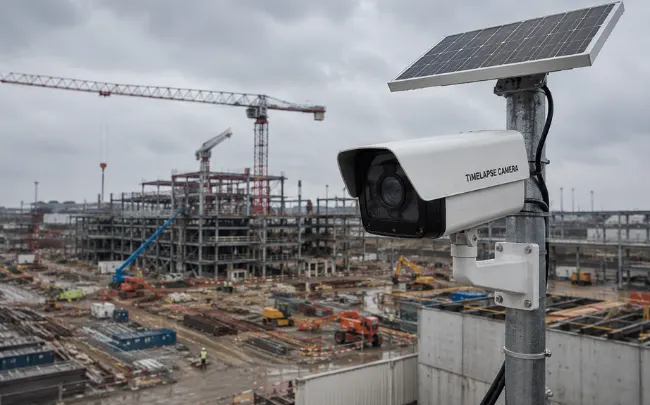
Image Comparison Does the Heavy Lifting
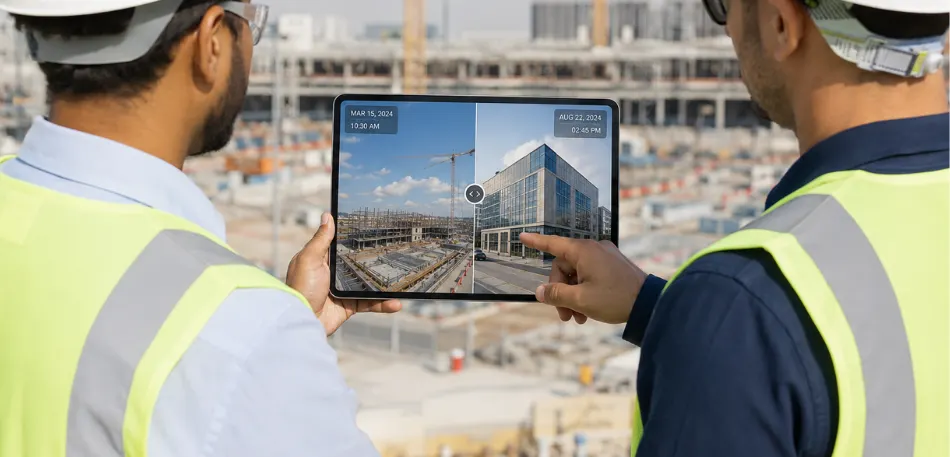
The feature that resolves disputes fastest isn’t the daily photo. It’s an image comparison, where two dates get placed side by side, slider or split view, and the difference is visible without anyone needing to argue about it. If a contractor claims the steel framework was up by a certain week and the client disputes it, pulling two dated images from the archive answers the question in under a minute. This matters more on sites where five or six contractors work different zones of the same project at once. Nobody is walking the whole footprint daily, so a shared visual record becomes the one thing every party is looking at together.
Building Site Surveillance Camera: Documentation Standards Shift by Region
Germany treats this kind of record keeping as an extension of a process that already runs on heavy documentation. Bauamt approval and German building codes expect a paper and photo trail from planning through construction, and industrial builds often have an auditable process written directly into the contract. Any building site surveillance camera system touching a German site also has to satisfy GDPR requirements for how footage is stored and handled, which shifts data handling from a nice-to-have into a genuine compliance item.
Camera timelapse in Germany works through Rawad, which runs on mains-powered DSLR box cameras at 24MP or 45MP for most sites, with 360-degree monitoring layered in for larger industrial builds needing coverage across multiple zones. Contractors researching the best cameras for timelapsein UK builds land in the same regional rollout, where construction disputes often move through formal adjudication once informal resolution stalls, another reason a dated visual record carries weight before a disagreement ever reaches that stage.
Building the Record Before You Need It
The mistake most contractors make is treating camera monitoring as something to add once a dispute has already started. By then the early stages of the build, the parts most likely to get questioned later, are gone. A timelapse camera solutions setup installed at the groundbreaking has the whole project on record if a question ever comes up, rather than three months of it.
Final Thoughts
A camera on a pole doesn’t prevent every disagreement between a contractor and a client. What it does is remove the guesswork once one starts. If your current site record is a folder of phone photos and a memory of what happened last month, that gap is worth closing before the next dispute, not during it. What’s currently sitting in your project file if someone questioned last month’s progress today?
FAQ
Can footage from a building site surveillance camera actually be used in a contractor dispute?
Dated, timestamped visual records are widely accepted as supporting evidence in construction disagreements, particularly for questions about progress timing or site conditions on a given date. It's not a replacement for proper contract documentation, but it strengthens whatever record already exists.
How far back can I pull old footage if a dispute comes up months later?
That depends on the storage setup. Systems built for construction monitoring, rather than standard CCTV, are usually designed for long-term retrieval rather than short rolling storage that gets overwritten after a few weeks.
Do I need a laser scan too, or is a timelapse camera enough?
Timelapse footage shows how a project changed over time, which covers most delay and workmanship questions. A laser scan adds exact measurements for disputes where the argument comes down to millimeters, not just whether work happened.
Is this only useful for large commercial sites, or does it work for smaller builds too?
Smaller sites benefit too, especially where a single contractor and client are relying entirely on memory and phone photos. The dispute risk doesn't scale down just because the project does.
What happens to the footage if my project spans a country like Germany with strict data rules?
Any system operating on a German site needs to handle stored footage under GDPR requirements, covering how data is stored, who can access it, and how long it's kept. This is a standard operational requirement, not an optional add-on.
Leave A Comment