

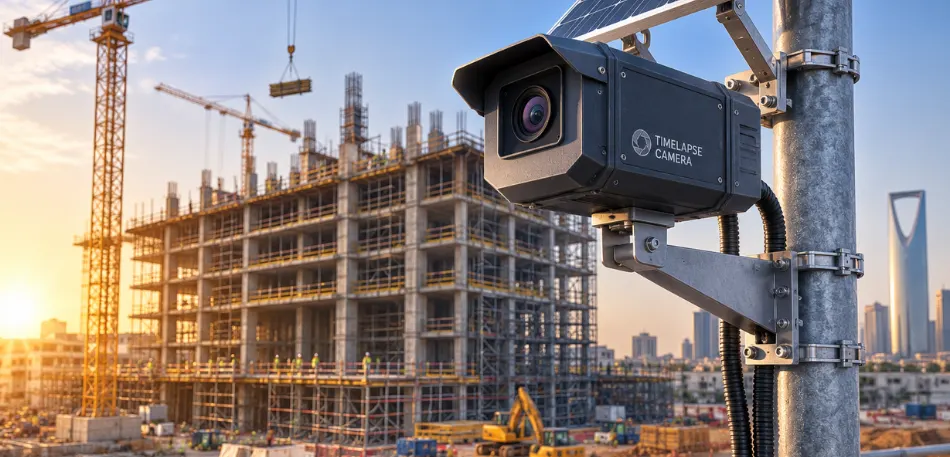
A stolen generator or a missing pallet of copper wiring usually doesn’t show up in a weekly progress meeting until the loss is already booked. That gap is why construction site security camera spending keeps climbing up the priority list on Gulf job sites, right behind scaffolding and concrete in what actually gets budgeted before ground even breaks. The real question isn’t whether to add cameras. It’s whether renting or buying gets a contractor better coverage for the money over the life of a project.
How Do Timelapse Cameras Complicate the Cost Question?
Security and progress monitoring used to sit in separate budget lines. On most Gulf sites now they don’t. Timelapse cameras built for daily progress photography increasingly carry the same sensors used for perimeter security, so a single unit ends up doing two jobs. A solar or mains-powered unit shooting at up to 45 megapixels can run AI detection for vehicles, people, and safety gear in the same feed it uses to build a time-stamped record from groundbreaking to handover. That overlap changes the rental-versus-purchase math, because a contractor comparing quotes for a dedicated CCTV rig against a combined timelapse-and-security package is no longer comparing like for like.
Renting a Security Camera System: What to Weigh
Renting suits a site with a fixed, known end date. Most rental agreements bundle installation, maintenance, and removal into one fee, so there’s no equipment sitting in a warehouse after handover with no next project lined up. It also shifts the failure risk. A camera that dies in month four of a rental term gets swapped by the vendor, not repaired by an in-house technician who has six other things to fix that week. The tradeoff is flexibility without ownership. Nothing on the fence line belongs to the contractor once the contract ends, and a short-notice extension can cost more per month than the original term did.
Buying Outright: When Ownership Makes Sense
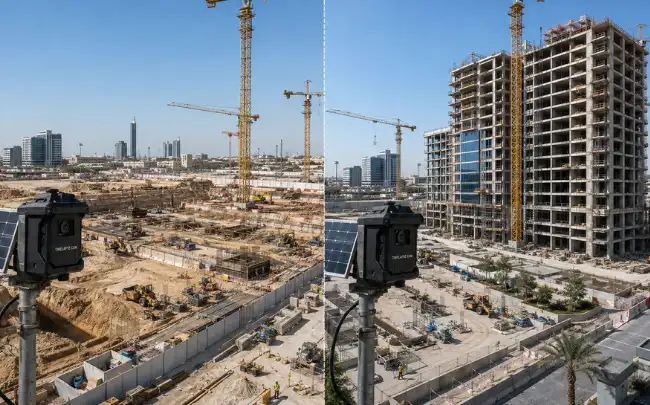
Buying tends to pay off on multi-year builds or for firms running several sites at once where the same hardware can be redeployed. The logic mirrors how contractors already think about heavier equipment: the true cost of an asset is the acquisition price minus whatever it’s worth when you eventually retire or resell it, a break-even framework CONEXPO-CON/AGG has laid out for equipment purchases in general, and it holds just as well for camera systems as it does for excavators. Ownership also means the AI detection rules, restricted-zone alerts, and unattended-object tracking can be configured once and reused across projects instead of renegotiated with a new rental vendor each time. The catch is upkeep. A purchased system needs someone accountable for firmware updates, damaged units, and storage once the cameras aren’t actively monitoring a live site, and that responsibility doesn’t disappear just because the lease payments did.
Where Regional Site Conditions Change the Calculation
Saudi Arabia’s giga-projects, NEOM and Qiddiya among them, often sit far enough from grid infrastructure that a solar-powered camera isn’t a preference; it’s the only workable option. That single detail can tip a contractor toward a rental package built specifically for off-grid deployment rather than a general-purpose purchase that assumes mains power. In the UAE, particularly around dense high-rise builds in Dubai and Abu Dhabi, the constraint runs the other way. Space for equipment is limited, and ANPR-based vehicle tracking at a single gate often matters more than a distributed 360-degree camera network. A timelapse construction camera in UAE deployment and a best time lapse camera Saudi Arabia setup can look like completely different equipment lists even when the underlying goal, proving what happened and when, is identical.
Making the Construction Site Security Camera Decision
There’s no universal answer, and any vendor promising one is skipping the parts of the brief that actually matter: contract length, site power access, and how many other projects the hardware might serve next. A twelve-month build with a hard end date leans toward renting. A firm with a five-year pipeline of Riyadh or Dubai projects usually gets more value from owning equipment it can move between sites. The honest exercise is mapping out the next eighteen months of work before signing anything.
Final Thoughts
Construction site security camera cost comparisons that only look at monthly rental fees against a purchase price miss half the picture. Maintenance, redeployment, and who owns the AI configuration once a project wraps all belong in that spreadsheet too. What does your next twelve months of site activity actually look like, and does that timeline point you toward owning the hardware or renting it project by project?
FAQ
Is it cheaper to rent or buy a construction site security camera?
It depends on how long the equipment stays busy. A single short project usually favors renting since maintenance and removal are already covered. Owning pays off when the same cameras move between several job sites over a few years.
Do timelapse cameras double as security cameras?
Often, yes. Many units built for daily progress photography now include AI detection for people, vehicles, and restricted zones, so one camera can cover both jobs instead of running separate systems.
What happens to a rented camera system after the project ends?
The vendor typically handles removal and takeover under the rental agreement. Nothing stays with the contractor, which is part of why renting suits short, defined builds better than long ones.
Can a solar-powered camera work on a remote Saudi site with no grid power?
Yes, that's specifically what solar units are built for. Sites tied to giga-projects like NEOM often sit far from existing infrastructure, and a mains-dependent camera simply isn't an option there.
Should a Dubai high-rise site prioritize vehicle tracking over full perimeter coverage?
Often, given how tight space gets on dense urban builds. Gate-level ANPR tracking can matter more day to day than a wide camera network when the site footprint itself is small.
Leave A Comment