

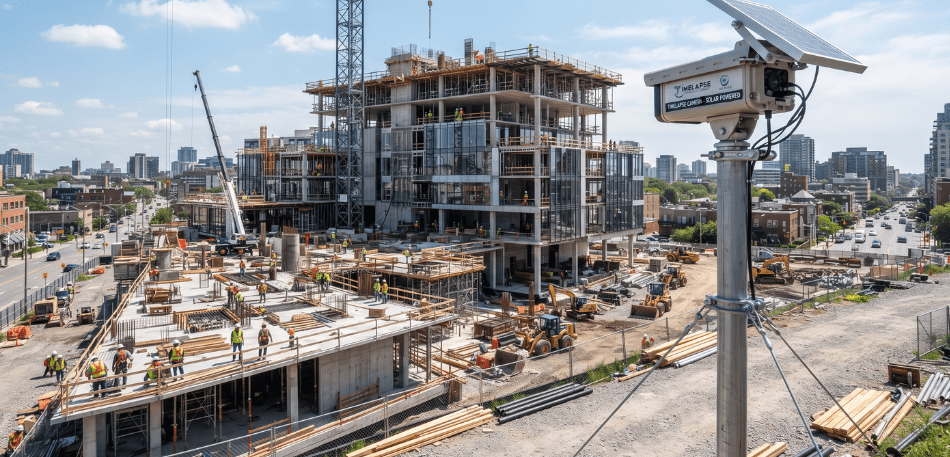
Project management tracking on a construction site used to mean a site diary, a weekly photo folder, and a status call that everyone half trusted. That works fine on a small job. It falls apart once a project spans several zones, multiple contractors, and a client who wants proof, not a summary. A dated camera feed changes what tracking actually looks like day to day, and it does it without anyone needing to walk the site to confirm what’s true.
How Do Timelapse Cameras Support Project Management Tracking?
Timelapse cameras solve a specific problem: someone senior needs to know where a project stands, and they need it without relying on a phone call from the site manager. A camera mounted at a fixed point captures stills on a schedule, solar or mains powered depending on what the site has available. Those images feed into a dashboard, get stitched into a running video, and sit there ready for anyone with a login to check. Timelapse camera solutions cover the full build, from installation through the type of camera that suits a given site, whether that’s a 12MP unit for standard progress work or something closer to 45MP where image detail actually matters.
The AI layer is what separates the system from a security camera that happens to take timelapse footage. Vehicles, people, and hard-hat compliance get flagged automatically, so nobody is scrubbing through weeks of stills by hand looking for the one frame that answers a question. The Project Management Institute notes that visual, time-stamped progress data is increasingly treated as standard evidence in construction reporting, not a nice extra.
What Changes for Reporting Once the Data Is Visual
Reports built from a camera feed carry weight that a written update doesn’t. A scheduled PDF pulled from a dashboard shows exactly what a site looked like on a given date, side by side with an earlier date if a comparison is needed. That matters most when a delay is questioned or a dispute lands on someone’s desk months after the fact. Dated footage tends to settle those arguments faster than anyone’s memory of what happened.
It also changes who gets access. Investors, consultants, and project managers can log into the same dashboard rather than waiting on a summary written by whoever happened to be on site that week. One login, one shared version of events, and no five different accounts of the same three months.
Choosing a Setup for Saudi Arabia and the UAE
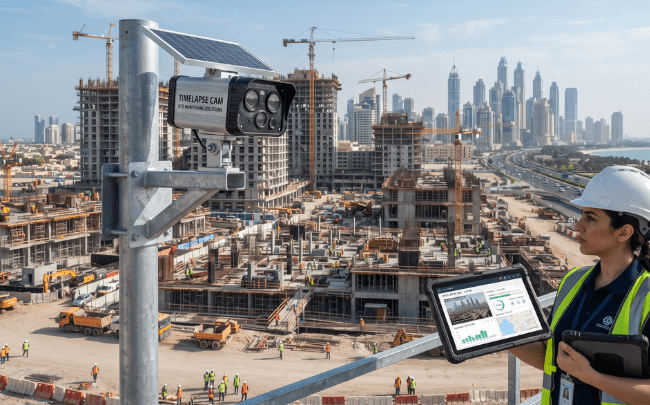
Site conditions differ enough between markets that the camera choice should follow the site, not the other way round. Anyone comparing options for the best time lapse camera in Saudi Arabia is usually weighing solar power against mains, particularly on projects like NEOM or Qiddiya, where grid infrastructure may not exist yet at that stage of the build. A solar unit runs off-grid and keeps capturing regardless of what power is or isn’t available nearby.
A timelapse construction camera in UAE developments faces a different set of constraints. Dense urban sites in Dubai or Abu Dhabi often already run CCTV, and integrating existing hardware into a monitoring platform avoids the cost and disruption of installing new cameras from scratch. Where a site spans a footprint too wide for one camera to cover, whether that’s a giga-project in the Kingdom or a large mixed-use development in the Emirates, multiple cameras or 360° coverage from fixed control points keep the whole site inside one dashboard instead of several disconnected feeds.
Turning Site Data Into Reports Stakeholders Actually Read
None of this matters if the output still needs reformatting before a client or board sees it. Reports generated straight from the platform, weekly, bi-weekly, or on demand, are built to be handed over as they are. A project manager isn’t spending an evening building a slide deck from screenshots; the report already exists in a format a ministry, a consultant, or an investor can open and understand without a walkthrough.
That’s really what project management tracking has become on projects at this scale. Less a diary someone updates from memory, more a dated visual record that answers “where are we right now” the same way for everyone looking at it, whether they’re standing on site or reading the report from another country.
Final Thoughts
A camera on a pole sounds like a small addition to a construction project. In practice, it changes who can answer for progress and how fast a question gets settled. If your current tracking still depends on someone’s weekly summary, it might be worth asking what a dated, visual record would change on your next report.
FAQ
Is a timelapse camera the same thing as a regular site CCTV?
Not quite. Standard CCTV usually overwrites footage monthly and needs cabling or a LAN connection. A timelapse setup like Binalapse backs up instantly, keeps footage indefinitely, and builds the timelapse video automatically, none of which typical CCTV does on its own.
Do I need to remove my existing cameras to start tracking progress this way?
No, and that surprises a lot of people. Most existing IP camera or CCTV systems can integrate directly into the platform, so you get time-lapse and reporting without replacing hardware that's already working fine.
How often can I actually get a progress report?
Scheduled reports can land weekly, bi-weekly, or monthly, and you can also pull one on demand whenever a client or consultant needs an answer sooner than the schedule allows. Both options come as ready-to-share PDFs.
What happens if my site has no reliable power connection?
Solar-powered units are built for exactly that. They run off-grid, which matters on projects like NEOM, where mains infrastructure might not exist at the stage the cameras go in.
Can investors or consultants check progress without contacting the site team directly?
Yes. Anyone with dashboard access, whether that's a project manager, a consultant, or an investor, can log in and view live feeds, comparisons, and reports without needing someone on site to relay information first.
Leave A Comment