

Expert Construction Contractors
for Turnkey Building Solutions
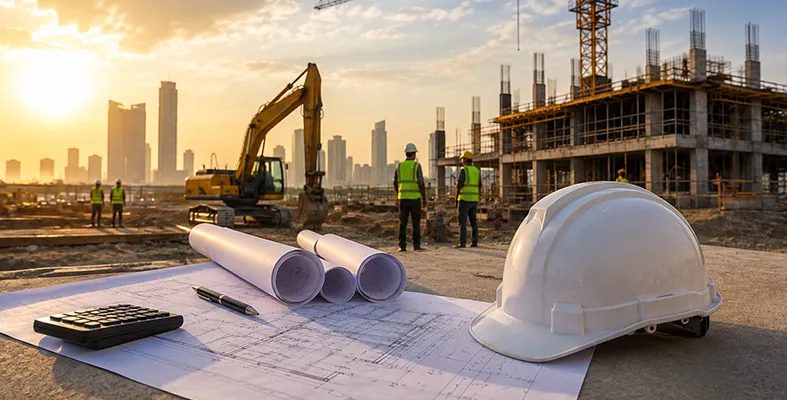
Riyadh’s skyline shifts every few months, and behind every new tower or transit hub sits a team of construction builders coordinating architects, structural engineers, and MEP crews long before the first slab is poured. We’re one of the construction contractors handling that coordination across Saudi Arabia, working from our Riyadh office in Al Anoodh Tower, Olaya, out to project sites in Diriyah, Qiddiya, and along the Kingdom’s rail network.
We describe ourselves as a multidisciplinary engineering and construction company, and our scope backs that up. Architecture, civil works, mechanical systems, and electrical systems sit under one roof, so a client isn’t handing the same project to four separate firms and hoping the drawings line up on site later. That structure exists to support Saudi Arabia’s Vision 2030 building pipeline, where timelines are tight and rework is expensive.
What a Full-Service Construction Company Actually Covers
A building construction company that only pours concrete isn’t much use once a building needs power, water, and a working HVAC system. Our model bundles architectural and civil work with mechanical, electrical, and plumbing engineering, plus what we call smart ecosystems: building automation, energy-efficient systems, and the digital connectivity most facilities managers expect by handover day.
That combination matters for any construction contractor working on more than a single villa. A hospitality building, for example, needs its MEP and civil teams talking from the concept stage onward, not after the structure is already standing.
Our Core Construction Services
- Architectural and Civil Construction: Structural design, site works, and building construction that carries a project from foundation to finished envelope.
- MEP Engineering: Climate control, electrical infrastructure, plumbing, and life-safety systems installed and tested as one coordinated package rather than three separate subcontracts.
- Smart Ecosystems: Automation and energy-efficient building technology layered in during construction, not retrofitted afterward.
- Turnkey Project Delivery: A single point of contact from concept development through final handover, which we treat as our core delivery model.
Industrial Building Construction and Large-Scale Projects
Industrial building construction carries different pressures than a residential block. Equipment loads, ventilation runs, and access for heavy plants all have to be designed in from day one, not added later. Our project list includes work tied to national infrastructure programs, among them the NEOM office project, the Qiddiya road project, and site work connected to Aramco’s Jafurah development, alongside transit-focused builds like the Diriyah Transportation Hub. These are projects where a construction contractor has to work inside someone else’s master schedule, not set its own.
Commercial and hospitality developments follow a similar logic on a different scale. Projects such as Mall of Saudi and the Red Sea school sit on our client roster, which means the same civil and MEP teams move between retail, education, and hospitality builds rather than specializing in just one building type.
Why Riyadh Developers Choose Us as Their Construction Contractor
Trust in construction comes from documentation as much as from finished buildings.
Our work gets reviewed by international consultancies
On mega-projects like Qiddiya road project and the Diriyah Company’s Phase 2 works, firms such as Jacobs Engineering, KEO International Consultants, and MACE have reviewed and signed off on submittals tied to our site work. That kind of review is standard practice on major developments, and it carries more weight than anything we could say about ourselves.
Our project list includes national landmarks
We’ve worked on the NEOM office project, the Diriyah Transportation Hub, and the MBS stadium project, putting us inside some of the Kingdom’s highest-profile Vision 2030 developments, not just smaller private builds.
We operate in multiple markets
We’re headquartered in Riyadh with a second base in Dubai, and we deliver construction, MEP, and electrical work across Saudi Arabia, the UAE, the UK, the USA, and Germany, backed by more than 15 years in the industry.
We give early clients free digital monitoring
Under our Signature Launch program, first clients get complimentary digital project monitoring, including 24/7 high-resolution timelapse documentation, 360-degree interior progress monitoring, and a secure cloud dashboard. If you can’t be on site every day, that’s a direct line of sight into your build rather than a monthly written update.
Our leadership has names, not job titles
Muhammed Shahabad serves as our civil director and Mohammed Ahmed leads MEP. We built our company values, among them “Build Trust” and “Deliver with Purpose,” around repeat relationships rather than one-off contracts.
How Our Build Process Works, From Planning to Handover
Every project starts with the same groundwork: site assessment, design coordination between architecture and MEP, and a construction sequence that accounts for approvals and material lead times specific to the Saudi market. From there:
- Our civil and structural teams handle foundations, superstructure, and building envelopes.
- MEP crews run in parallel once the structure allows it, instead of waiting for a full handover of each floor.
- Smart systems and finishes go in during the final stage, tested before the client walkthrough.
- Snagging and final inspection happen before keys change hands, not after.
Safety standards and quality control run through each stage rather than sitting as a final checklist. That’s the difference between managing risk and discovering it late.
Getting Started
The construction contractors are only as useful as the questions they can answer before contracts are signed: who handles MEP, how site records get resolved if a dispute comes up, and who’s accountable if a subcontractor falls behind schedule. Our Riyadh office, at Al Anoodh Tower in Olaya, is the starting point for that conversation, whether your project is a single commercial build or one phase within a larger Vision 2030 development.
FAQ
What do construction builders actually manage on a project?
Construction builders coordinate the physical build, including civil works, structural construction, and often MEP installation, while managing subcontractors, site safety, and the schedule from groundbreaking to handover.
Are you only involved in construction, or do you also handle project monitoring?
Both. We run civil, architectural, and MEP construction work directly, then layer optional digital monitoring, including timelapse cameras and cloud dashboards, on top of the same projects for clients who want remote visibility.
Do you handle industrial building construction?
Yes. Our project experience includes site work tied to large-scale industrial and infrastructure developments such as the Aramco Jafurah project and the Qiddiya road project, alongside commercial and hospitality builds.
Where in Saudi Arabia do you operate as a construction contractor?
We're headquartered in Riyadh's Olaya district and have delivered project work across the wider Kingdom, including Diriyah, Qiddiya, and NEOM-linked developments.
How can a client stay updated on a build without visiting the site daily?
Clients on our Signature Launch program get access to a secure cloud dashboard with timelapse photo records and progress documentation, so site visits become optional instead of the only way to check status.
Services
Any Questions? Let’s talk
- Al Haram Project
- Mall of Saudi Project
- Saudi Railway
- NEOM Office Project
- Qiddiya Road Project